Because precisely no one asked for it and I need some feedback here is the script, tentatively called Blackout, the latest P.I. film. It's a bit . . . different. Very Dame-centric. I'm looking to film it (haha, record it) this summer.
Comments welcome.
Sunday, April 14, 2013

Friday, April 12, 2013
You Watch Television?!
You're right. This is a new thing. I didn't used to watch television. I occasionally enjoyed the extremely time shifted pleasures of seasons past (Doctor Who, Psych, Burn Notice, Top Gear, 30 Rock) when they finally hit Netflix. But it turns out, I had severely misunderstood the state of On Demand. In my defense, I haven't paid for cable in three or so years and three years ago "On Demand" meant straight to video crap, renting movies, and nothing else. If you wanted to timeshift a show, you had to know which one that was going to be and record it your own damn self. My sister, a proud homeowner now, inadvertently clued me in to the new world order. On Demand now means that ALL of the regular television shows have been DVRd already and you can pick and choose je nach Laune, as the Germans say (or might if they were translating an American expression into German, let's roll with it), which is awesome in its brilliance (and it took years for them to figure this out because . . . ).
Knowing of the existence of On Demand's in season vault is great and it will change my TV watching habits, but it will not help me with the cultural void that developed over the last couple of years (the lacking access to cable years). I have deliberately kept myself out of the conversations of Mad Men, Walking Dead, Breaking Bad, House of Lies and every HBO show worth watching, which is, frankly, all of them. (A note to HBO, if you are listening: Make HBO Go available to people who aren't subscribers. I don't buy cable in my household, but I would happily give you money to watch your amazing shows. Every month.) I consider that a good thing. If you are someone who cares about those shows, you don't need to listen to me.
But now that I have cracked the On Demand code, I feel like there are shows out there that I can get in on the ground floor on, shows like NBC's Hannibal. What I understand from those in the know is that NBC has no idea what to do with this show, it's in the Thursday night death slot (the one that used to belong to E.R. - oh, how the mighty have fallen), and it might get cancelled once the initial run has aired. It makes you feel bad for Bryan Fuller. Fuller is responsible for Wonderfalls, Dead Like Me, Pushing Daisies, and Heroes. Not one of those shows lasted for even three full seasons. So, just be forewarned: Hannibal will be cancelled soon.
Which is a shame because Hannibal is AWESOME. I don't use those capital letters lightly. Thomas Harris is responsible for bringing us the character of Hannibal Lecter and the universe that grew up around it. His novels, Red Dragon, Silence of the Lambs, and Hannibal, inspired four movies, a musical (I wish I was kidding) and now a television show and, you could argue, created the serial killer/profiler as a genre. Silence of the Lambs is one of the greatest films of all time, a document so complete and authoritative that it is impossible to explore those characters any further. Hannibal, the movie and the novel, attempted it and failed. Even Ridley Scott directing Julianne Moore couldn't add anything substantial to the Lecter/Starling story. But then you have Red Dragon.
Red Dragon is the back story of Silence. It's primarily about Will Graham, a profiler who was so empathetic that he could solve murders from inside the murderer's head, that he could think the murderer's thoughts. That's a compelling character that you could explore forever, right? And then on top of that, we get Hannibal Lecter, the brilliant sadist serial killer who helps Graham catch these killers. That's a dynamic that has automatic tension to it, it's just too juicy. So juicy, that you've got two movies that try to deal with it, mostly unsuccessfully (Manhunter succeeds far more than the dull and obvious Red Dragon - I'll take Michael Mann over Brett Ratner any day of the week), and now, we have the medium necessary to explore the complete complexity of this dynamic: television.
Television allows David Slade (Hard Candy - do yourself a favor, watch) and Bryan Fuller to take their time, to let the dynamic unfold in front of us, with that delicious sense of inevitability, that wonderful suspense that Hitchcock talks about: watching the time bomb under the cafe table tick down inexorably to that final explosive moment. Hugh Dancy is great as Will Graham, who has been invited as a kind of idiot savant, who has little or no social skills, no use for social niceties, and who is clearly damaged by the use of his empathetic gifts. The show lets us into the Graham's world, to his torture, by re-enacting the crime scenes with Graham as the killer. It's highly stylized and totally immersive. But the real brilliance of the show is casting Mads Mikkelsen as Hannibal Lecter, an actor who is the polar opposite, in terms of technique, as Brian Cox and Anthony Hopkins. Mikkelsen is a master of the subtle, cold, and calculating. He is outstanding in Casino Royale, but he has some Danish language work that is also brilliant, particularly the Dogme-95-lite piece, After The Wedding. Mikkelsen is a total . . . er . . . pleasure to watch. He is understated but always masterfully present.
But great actors and good style aren't enough to make this show work, though it helps tremendously. It's going to come down to the monsters these guys are hunting down on a weekly basis. Harris may have invented the the profiler/killer rules, but modern science has come to understand something about those early profilers: they were full of crap. Most serial killers are not loner white men who have trouble keeping a job. Many of them are dedicated family men and pillars of their community (which gibes with what we know of pure evil from . . . you know where, that place and the thing . . . do I really have to go there?). The first killer in the series is a family man killing girls like his daughter because she is about to leave the nest. Immediately, we know that we aren't going to be stuck with run of the mill psychos and loners. No Jame Gumb, no John Doe, no Dahmer. We are getting a great look at a very interesting dynamic and new look at what we think of evil.
So, yeah. I'm all in on Hannibal.
Knowing of the existence of On Demand's in season vault is great and it will change my TV watching habits, but it will not help me with the cultural void that developed over the last couple of years (the lacking access to cable years). I have deliberately kept myself out of the conversations of Mad Men, Walking Dead, Breaking Bad, House of Lies and every HBO show worth watching, which is, frankly, all of them. (A note to HBO, if you are listening: Make HBO Go available to people who aren't subscribers. I don't buy cable in my household, but I would happily give you money to watch your amazing shows. Every month.) I consider that a good thing. If you are someone who cares about those shows, you don't need to listen to me.
But now that I have cracked the On Demand code, I feel like there are shows out there that I can get in on the ground floor on, shows like NBC's Hannibal. What I understand from those in the know is that NBC has no idea what to do with this show, it's in the Thursday night death slot (the one that used to belong to E.R. - oh, how the mighty have fallen), and it might get cancelled once the initial run has aired. It makes you feel bad for Bryan Fuller. Fuller is responsible for Wonderfalls, Dead Like Me, Pushing Daisies, and Heroes. Not one of those shows lasted for even three full seasons. So, just be forewarned: Hannibal will be cancelled soon.
Which is a shame because Hannibal is AWESOME. I don't use those capital letters lightly. Thomas Harris is responsible for bringing us the character of Hannibal Lecter and the universe that grew up around it. His novels, Red Dragon, Silence of the Lambs, and Hannibal, inspired four movies, a musical (I wish I was kidding) and now a television show and, you could argue, created the serial killer/profiler as a genre. Silence of the Lambs is one of the greatest films of all time, a document so complete and authoritative that it is impossible to explore those characters any further. Hannibal, the movie and the novel, attempted it and failed. Even Ridley Scott directing Julianne Moore couldn't add anything substantial to the Lecter/Starling story. But then you have Red Dragon.
Red Dragon is the back story of Silence. It's primarily about Will Graham, a profiler who was so empathetic that he could solve murders from inside the murderer's head, that he could think the murderer's thoughts. That's a compelling character that you could explore forever, right? And then on top of that, we get Hannibal Lecter, the brilliant sadist serial killer who helps Graham catch these killers. That's a dynamic that has automatic tension to it, it's just too juicy. So juicy, that you've got two movies that try to deal with it, mostly unsuccessfully (Manhunter succeeds far more than the dull and obvious Red Dragon - I'll take Michael Mann over Brett Ratner any day of the week), and now, we have the medium necessary to explore the complete complexity of this dynamic: television.
Television allows David Slade (Hard Candy - do yourself a favor, watch) and Bryan Fuller to take their time, to let the dynamic unfold in front of us, with that delicious sense of inevitability, that wonderful suspense that Hitchcock talks about: watching the time bomb under the cafe table tick down inexorably to that final explosive moment. Hugh Dancy is great as Will Graham, who has been invited as a kind of idiot savant, who has little or no social skills, no use for social niceties, and who is clearly damaged by the use of his empathetic gifts. The show lets us into the Graham's world, to his torture, by re-enacting the crime scenes with Graham as the killer. It's highly stylized and totally immersive. But the real brilliance of the show is casting Mads Mikkelsen as Hannibal Lecter, an actor who is the polar opposite, in terms of technique, as Brian Cox and Anthony Hopkins. Mikkelsen is a master of the subtle, cold, and calculating. He is outstanding in Casino Royale, but he has some Danish language work that is also brilliant, particularly the Dogme-95-lite piece, After The Wedding. Mikkelsen is a total . . . er . . . pleasure to watch. He is understated but always masterfully present.
But great actors and good style aren't enough to make this show work, though it helps tremendously. It's going to come down to the monsters these guys are hunting down on a weekly basis. Harris may have invented the the profiler/killer rules, but modern science has come to understand something about those early profilers: they were full of crap. Most serial killers are not loner white men who have trouble keeping a job. Many of them are dedicated family men and pillars of their community (which gibes with what we know of pure evil from . . . you know where, that place and the thing . . . do I really have to go there?). The first killer in the series is a family man killing girls like his daughter because she is about to leave the nest. Immediately, we know that we aren't going to be stuck with run of the mill psychos and loners. No Jame Gumb, no John Doe, no Dahmer. We are getting a great look at a very interesting dynamic and new look at what we think of evil.
So, yeah. I'm all in on Hannibal.
Saturday, March 2, 2013
Shaking Off the Post-Oscar Blues
The Oscars are finally, mercifully, over. We can all stop thinking about 2012, the movie year that was, and get pumped about what is going to happen next, now that everyone has moved on. I don't care to predict what I will want to see in October or anything. The movie year has seasons, too, so I want share five movies that I can't wait to see in the Post-Oscar/Pre-Summer Tentpole season. Arbitrary cut-off date: May 3. Summer movie season used to start Memorial Day Weekendendend. But they are releasing Iron Man III on May 3. Clearly, the summer silly season starts then.
One caveat, I didn't want to waste anyone's time with movies that are all going to see anyway. I don't need to tell you about Oz the Great and Powerful. It's Disney, they've been pounding on your door for a while. Also, horror movie fans and Sam Raimi fans already know about Evil Dead, no one needs me for that (or for anything really, I'm just thinking about it, it's what the internet is for: shouting into the void when it all gets too pent up inside). Anyway, I'm trying to look between the arthouse and the blockbuster here. Nothing too snobbish (I am a snob so some of it is going to be, you know . . .) and nothing too obvious.
Honorable Mentions: Pain and Gain (yay, trashy Michael Bay is back!), Place Beyond the Pines (Ryan Gosling is now required viewing.), From up on Poppy Hill (Studio Ghibli is back). Admission (because Tina Fey).
5. Like Someone in Love - Abbas Kiarostami was forced on me as part of World Film History course. Anyone who has been subjected to it, or it's bastard cousin, World Theatre, knows what a grind those experiences can be. But A Taste of Cherry is truly a classic, outstanding movie by an Iranian guy, which I never would have found on my own. Kiarostami is now working outside Iran (by some miracle). His latest takes place in Japan. I've heard it's beautiful and that no summary can possibly cover how intricate the film is. I'm in. Technically, it's available on demand already. I just hope an arthouse place picks it up so I can see it in the theater.
4. 42 - I'm a sports fan, a huge one, totally head over heels in love with baseball. Jackie Robinson's story is so epic, so important to the history of sport and society, that you really have to try to screw it up. It's just drama. It doesn't always make it to the screen, but I really want this movie to do justice Jackie Robinson and to one of the best sports stories in all of sports history. And Harrison Ford is in it. Not a guarantee of success or anything, but hey, Indy gets the benefit of the doubt.
3. Stoker - The English language debut of the outrageously good Chan-wook Park, the director of the insanely awesome (and by the end of it, just literally insane) Vengeance trilogy, capped off by the brilliant Oldboy. This one looks creepy and mindblowing. I'd watch because of Park, but it has the added benefit of Nicole Kidman and Mia Wasikowska (doing what looks like a Saorise Ronan impersonation. Poor Saorise, stuck making all that money in that terrible movie, The Host. #FreeSaorise).
2. John Dies at the End - I'm cheating on the release dates here. Technically John Dies at the End is already out, but you have to make a real effort to see it, so I'm going to let it stand. Basically, the gist of it is . . . Paul Giamatti's in it. And it was directed by Bubba Ho-tep's own Don Coscarelli (alright, there is a Phantasm or two in there). While we continue the wait for Bubba Nosferatu (along with the Arrested Development movie: both are JUST around the corner).
1. Before Midnight - The last film in the Before trilogy, Richard Linklater's fascinating character studies. Giving Linklater all the credit isn't right. Ethan Hawke and Julie Delpy are incredibly important co-creators in these free form real time encounters between two people who only see each other every decade or so. Before Sunset is one of my favorite films of all time. It's so incredible, what essentially one long continuous shot (though if you don't want to, you don't have to notice how brilliant it is, much like Soderbergh's camera work) and one long meandering conversation can achieve. Really desperately looking forward to this one. Also, I cheated, this one is out in late May, well into silly season. I want to see that much, I broke my own temporary arbitrary rules to include it.
One caveat, I didn't want to waste anyone's time with movies that are all going to see anyway. I don't need to tell you about Oz the Great and Powerful. It's Disney, they've been pounding on your door for a while. Also, horror movie fans and Sam Raimi fans already know about Evil Dead, no one needs me for that (or for anything really, I'm just thinking about it, it's what the internet is for: shouting into the void when it all gets too pent up inside). Anyway, I'm trying to look between the arthouse and the blockbuster here. Nothing too snobbish (I am a snob so some of it is going to be, you know . . .) and nothing too obvious.
Honorable Mentions: Pain and Gain (yay, trashy Michael Bay is back!), Place Beyond the Pines (Ryan Gosling is now required viewing.), From up on Poppy Hill (Studio Ghibli is back). Admission (because Tina Fey).
5. Like Someone in Love - Abbas Kiarostami was forced on me as part of World Film History course. Anyone who has been subjected to it, or it's bastard cousin, World Theatre, knows what a grind those experiences can be. But A Taste of Cherry is truly a classic, outstanding movie by an Iranian guy, which I never would have found on my own. Kiarostami is now working outside Iran (by some miracle). His latest takes place in Japan. I've heard it's beautiful and that no summary can possibly cover how intricate the film is. I'm in. Technically, it's available on demand already. I just hope an arthouse place picks it up so I can see it in the theater.
4. 42 - I'm a sports fan, a huge one, totally head over heels in love with baseball. Jackie Robinson's story is so epic, so important to the history of sport and society, that you really have to try to screw it up. It's just drama. It doesn't always make it to the screen, but I really want this movie to do justice Jackie Robinson and to one of the best sports stories in all of sports history. And Harrison Ford is in it. Not a guarantee of success or anything, but hey, Indy gets the benefit of the doubt.
3. Stoker - The English language debut of the outrageously good Chan-wook Park, the director of the insanely awesome (and by the end of it, just literally insane) Vengeance trilogy, capped off by the brilliant Oldboy. This one looks creepy and mindblowing. I'd watch because of Park, but it has the added benefit of Nicole Kidman and Mia Wasikowska (doing what looks like a Saorise Ronan impersonation. Poor Saorise, stuck making all that money in that terrible movie, The Host. #FreeSaorise).
2. John Dies at the End - I'm cheating on the release dates here. Technically John Dies at the End is already out, but you have to make a real effort to see it, so I'm going to let it stand. Basically, the gist of it is . . . Paul Giamatti's in it. And it was directed by Bubba Ho-tep's own Don Coscarelli (alright, there is a Phantasm or two in there). While we continue the wait for Bubba Nosferatu (along with the Arrested Development movie: both are JUST around the corner).
1. Before Midnight - The last film in the Before trilogy, Richard Linklater's fascinating character studies. Giving Linklater all the credit isn't right. Ethan Hawke and Julie Delpy are incredibly important co-creators in these free form real time encounters between two people who only see each other every decade or so. Before Sunset is one of my favorite films of all time. It's so incredible, what essentially one long continuous shot (though if you don't want to, you don't have to notice how brilliant it is, much like Soderbergh's camera work) and one long meandering conversation can achieve. Really desperately looking forward to this one. Also, I cheated, this one is out in late May, well into silly season. I want to see that much, I broke my own temporary arbitrary rules to include it.
Thursday, February 7, 2013
God Made a What?
I am a child of the late eighties (meaning I was born in the early eighties, natch). I lived in Nebraska during a critical time in my childhood development. Paul Harvey's voice meant a lot to me. It still means "radio." It was my "This American Life," when I was growing up. "And now you know . . . the rest of the story" is a phrase indelibly etched into the folds of my brain. So I thought glowing and pleasant thoughts about Paul Harvey's voice being part of a Dodge commercial. Until I heard it anyway.
You see, in the interim, between childhood and whatever the hell age I am now, which I'd rather not mention, thank you, very much, I've acquired a keen interest in economics. And in the economic world, there is not room for wistful nostalgia and Paul Harvey's 1978 speech was without question, even in 1978, indulging in the worst excesses of nostalgia. But that's not a message people want to hear. Economics has a well-earned reputation as the dismal science, and is anyway in disrepute with a number of people fond of this speech.
But then, I also happen to have read the Bible a time or two. And Genesis has some very interesting things to say on this subject (here's the whole of chapter 3 for you completionists):
17 To Adam he said, “Because you listened to your wife and ate fruit from the tree about which I commanded you, ‘You must not eat from it,’
Call me crazy, but I don't think God felt that way about farmers, pretty much at all.
You see, in the interim, between childhood and whatever the hell age I am now, which I'd rather not mention, thank you, very much, I've acquired a keen interest in economics. And in the economic world, there is not room for wistful nostalgia and Paul Harvey's 1978 speech was without question, even in 1978, indulging in the worst excesses of nostalgia. But that's not a message people want to hear. Economics has a well-earned reputation as the dismal science, and is anyway in disrepute with a number of people fond of this speech.
But then, I also happen to have read the Bible a time or two. And Genesis has some very interesting things to say on this subject (here's the whole of chapter 3 for you completionists):
17 To Adam he said, “Because you listened to your wife and ate fruit from the tree about which I commanded you, ‘You must not eat from it,’
“Cursed is the ground because of you;
through painful toil you will eat food from it
all the days of your life.
18 It will produce thorns and thistles for you,
and you will eat the plants of the field.
19 By the sweat of your brow
you will eat your food
until you return to the ground,
since from it you were taken;
for dust you are
and to dust you will return.
through painful toil you will eat food from it
all the days of your life.
18 It will produce thorns and thistles for you,
and you will eat the plants of the field.
19 By the sweat of your brow
you will eat your food
until you return to the ground,
since from it you were taken;
for dust you are
and to dust you will return.
Sunday, January 13, 2013
The Best Picture Requires the Best Director
Yesterday, I did a quick whip around on my thoughts of the Best Picture nominees. To refresh your memory without playing a fascinating game of follow the hyperlink, they are as follows:
Amour, Argo, Beasts of the Southern Wild, Django Unchained, Les Misérables, Life of Pi, Lincoln, Silver Linings Playbook, and Zero Dark Thirty
This is the intersection of that list with the Best Director nominees:
Amour,Argo, Beasts of the Southern Wild, Django Unchained, Les
Misérables, Life of Pi, Lincoln, Silver Linings Playbook, and Zero Dark
Thirty
Much has been made of the, ahem, snubs (DRINK!) in this category, but the Academy had the decency to put every Best Director nominee into the Best Picture discussion. Of course you don't step there with Best Picture, they add a few more flicks because . . . why the hell not? Like Wesley Morris, I don't think that snub is the right word. There is a size mismatch and that means some poor bastards, who made excellent movies, just won't make the cut. Let's ask ourselves why.
Tom Hooper lost out because, you know, Russell Crowe. Even if every other choice Hooper made was perfect (and it wasn't, thanks to his DP on amphetamines approach), Russell Crowe's casting torpedoed every shot at making this list. Horrible decision and that's all on one Tom Hooper, director.
It is clear to me that Kathryn Bigelow was not nominated for Zero Dark Thirty because she already won for this movie when it was called The Hurt Locker. A director gets the nod for their style and she did not change enough of her style to get a good streak going. No one has bucked this trend without seriously shifting gears. Eastwood's run comes to mind but, then again, he also made two completely different movies (Million Dollar Baby, still high in the running for worst movie title ever, and Mystic River). It's a shame because Zero Dark Thirty is better in a whole lot of ways, not the least dealing with weightier and much wider ranging subject matter.
Aside: if you are offended by the depictions of torture in this movie, then you have not seen Django Unchained and your opinion is worthless.
Of the four films whose directors did not get recognized, Django Unchained has the most going for it: a distinct voice, difficult issues, great performances, popular at the box office. The biggest problem is the violence and it kept Scorcese out forever as well. The bald fact is that the Academy is pretty mainstream and the extreme edges of cinema don't usually get recognized and that ain't changing. It's actually kind of a miracle that anyone is using "Quentin Tarantino" and "Oscar snub" in the same sentence. The Academy might not come all the way around until long after QT is done, but they have come mighty far in the last twenty years, I will give them that.
That brings us to Argo. I am reluctant to say this, so . . . if you love Argo, you should skip this paragraph and just keep on believing that Argo got jobbed and stupid Academy. I'll wait. I'll even give you a few sentences to make up your mind, because I value your opinion. Even if I don't agree with it. Because Argo is not a brilliant film. I compare it to the best suit you can buy at Macy's. It's a fine suit, cut looks good, good quality, name brand. There is nothing wrong with it as a suit . . . until you call it the best suit money can buy, which is flat out not true. Argo was wonderful to watch, I enjoyed the crap out of it. Affleck directed it well, it's well-crafted, and full of good decisions but . . . it's not a movie that is about anything other than the story of these hostages. I often found it predictable, well-executed, but . . . predictable. I think workman-like is a great comment and a huge compliment to Affleck and that no one should even be considering him for Best Director. I have zero problem with Affleck not being on this list given who else made this list. As much as I wish David O. Russell wasn't on it.
I loved Silver Linings Playbook. It's extremely hard to handle a story about mental illness that doesn't veer into pat, cheap, and easy solutions about mental illness and Silver Linings manages to hold off on pat, cheap, and easy until the very very end. Right up until then there are all kinds of crazy people and there is very little normal. And a ton of sports fandom, non-ridiculed, legit sports love. Unfortunately, this movie just doesn't have anything at stake other than the Solitano family and Tiffany (also the ending is such gratuitous wish-fulfillment - I wanted it for the characters, but sometimes when you make a great movie, you have to make choices for your characters that the viewer will not want - see Amour). Fun film, challenging material, well executed. But not on the same level as Taratino, who in addition to all the revenge and the killing and the repartee, made a film that was really about representations of race and America's perception of itself. And also lots of bullets and blood.
There are three movies that have serious depth, deal with all kinds of complicated issues and are brilliantly executed. Beasts of the Southern Wild, Amour, and Lincoln. The most likely to win is Lincoln, thanks to that idea that the Best Picture was made by the Best Director and Lincoln is the big time favorite for Pic. Spielberg had a really difficult task in making routine political business seem interesting and consequential enough to deserve fiction film treatment and he dispatches it with flair. Every scene in Congress is riveting and loaded with subtext. Daniel Day Lewis inhabits the roles of Lincoln as if he could talk to the man himself (now that's Method). It's good, it's really good, and I wouldn't be mad if Spielberg won it, which is good because he probably will.
But I would much rather see Amour or Beasts of the Southern Wild win because they are on another level entirely. Michael Haneke made a pitiless and unsentimental movie about an age-old fear (see what I did there? Age-old fear about being old, get it? GET IT?!) and a contemporary societal theme (aging and the quality of life). Every single frame of this film matters. It is hewn out of stone, cold, cold stone. It's claustrophobic, unflinchingly realistic, unsparing, and absolutely relevant. It does not indulge in a single extravagant emotion. There is not one shot wasted. It's almost certainly not going to win because it is so completely foreign, so remote; I just don't think Academy voters will connect with it (the audience I saw it with were certainly unprepared for it) and I accept that. It will almost certainly take Best Foreign Film, which is consolation of sorts.
But my Best Director, and Best Picture, belong to Benh Zeitlin and Beasts of the Southern Wild. This movie is so vibrant, so pulsing with life. Benh Zeitlin took challenging source material and made it live on screen and he used completely amateur actors and he made them look brilliant. It's visually stunning, emotionally resonant, and it means more than what it shows. It tackles giant issues like modernity and romanticism versus utilitarianism. He looks fondly at life on the margins, not as a problem to be solved, but as a rich source of hope for humanity. It's so resolutely American, a dream of what could be, what can be done . . . these characters absorb profound assaults on their world, then they survive, and keep on surviving. I really love this movie and I really love what the director accomplished. Fact is, most people missed this in theaters, but it is now available for rent from your friendly neighborhood digital movie dispensary and you should just do yourself a favor and see it (at 93 minutes, it is by far the shortest of those nominated in this category). Just see it.
So yes, I understand the groundswell for #AffleckWasRobbed and I wish #Argo the best, and now they have a bunch of Golden Globes to console themselves. It has a shot, there is obvious affection for it and the serious movie vote might split several ways leaving Lincoln short, so keep it up. Don't let the bastards grind you down. Just don't be surprised when Lincoln trashes everyone and pulls a It Happened One Night on the major awards (minus Best Actress because politics is a sausage fest).
Amour, Argo, Beasts of the Southern Wild, Django Unchained, Les Misérables, Life of Pi, Lincoln, Silver Linings Playbook, and Zero Dark Thirty
This is the intersection of that list with the Best Director nominees:
Amour,
Much has been made of the, ahem, snubs (DRINK!) in this category, but the Academy had the decency to put every Best Director nominee into the Best Picture discussion. Of course you don't step there with Best Picture, they add a few more flicks because . . . why the hell not? Like Wesley Morris, I don't think that snub is the right word. There is a size mismatch and that means some poor bastards, who made excellent movies, just won't make the cut. Let's ask ourselves why.
Tom Hooper lost out because, you know, Russell Crowe. Even if every other choice Hooper made was perfect (and it wasn't, thanks to his DP on amphetamines approach), Russell Crowe's casting torpedoed every shot at making this list. Horrible decision and that's all on one Tom Hooper, director.
It is clear to me that Kathryn Bigelow was not nominated for Zero Dark Thirty because she already won for this movie when it was called The Hurt Locker. A director gets the nod for their style and she did not change enough of her style to get a good streak going. No one has bucked this trend without seriously shifting gears. Eastwood's run comes to mind but, then again, he also made two completely different movies (Million Dollar Baby, still high in the running for worst movie title ever, and Mystic River). It's a shame because Zero Dark Thirty is better in a whole lot of ways, not the least dealing with weightier and much wider ranging subject matter.
Aside: if you are offended by the depictions of torture in this movie, then you have not seen Django Unchained and your opinion is worthless.
Of the four films whose directors did not get recognized, Django Unchained has the most going for it: a distinct voice, difficult issues, great performances, popular at the box office. The biggest problem is the violence and it kept Scorcese out forever as well. The bald fact is that the Academy is pretty mainstream and the extreme edges of cinema don't usually get recognized and that ain't changing. It's actually kind of a miracle that anyone is using "Quentin Tarantino" and "Oscar snub" in the same sentence. The Academy might not come all the way around until long after QT is done, but they have come mighty far in the last twenty years, I will give them that.
That brings us to Argo. I am reluctant to say this, so . . . if you love Argo, you should skip this paragraph and just keep on believing that Argo got jobbed and stupid Academy. I'll wait. I'll even give you a few sentences to make up your mind, because I value your opinion. Even if I don't agree with it. Because Argo is not a brilliant film. I compare it to the best suit you can buy at Macy's. It's a fine suit, cut looks good, good quality, name brand. There is nothing wrong with it as a suit . . . until you call it the best suit money can buy, which is flat out not true. Argo was wonderful to watch, I enjoyed the crap out of it. Affleck directed it well, it's well-crafted, and full of good decisions but . . . it's not a movie that is about anything other than the story of these hostages. I often found it predictable, well-executed, but . . . predictable. I think workman-like is a great comment and a huge compliment to Affleck and that no one should even be considering him for Best Director. I have zero problem with Affleck not being on this list given who else made this list. As much as I wish David O. Russell wasn't on it.
I loved Silver Linings Playbook. It's extremely hard to handle a story about mental illness that doesn't veer into pat, cheap, and easy solutions about mental illness and Silver Linings manages to hold off on pat, cheap, and easy until the very very end. Right up until then there are all kinds of crazy people and there is very little normal. And a ton of sports fandom, non-ridiculed, legit sports love. Unfortunately, this movie just doesn't have anything at stake other than the Solitano family and Tiffany (also the ending is such gratuitous wish-fulfillment - I wanted it for the characters, but sometimes when you make a great movie, you have to make choices for your characters that the viewer will not want - see Amour). Fun film, challenging material, well executed. But not on the same level as Taratino, who in addition to all the revenge and the killing and the repartee, made a film that was really about representations of race and America's perception of itself. And also lots of bullets and blood.
There are three movies that have serious depth, deal with all kinds of complicated issues and are brilliantly executed. Beasts of the Southern Wild, Amour, and Lincoln. The most likely to win is Lincoln, thanks to that idea that the Best Picture was made by the Best Director and Lincoln is the big time favorite for Pic. Spielberg had a really difficult task in making routine political business seem interesting and consequential enough to deserve fiction film treatment and he dispatches it with flair. Every scene in Congress is riveting and loaded with subtext. Daniel Day Lewis inhabits the roles of Lincoln as if he could talk to the man himself (now that's Method). It's good, it's really good, and I wouldn't be mad if Spielberg won it, which is good because he probably will.
But I would much rather see Amour or Beasts of the Southern Wild win because they are on another level entirely. Michael Haneke made a pitiless and unsentimental movie about an age-old fear (see what I did there? Age-old fear about being old, get it? GET IT?!) and a contemporary societal theme (aging and the quality of life). Every single frame of this film matters. It is hewn out of stone, cold, cold stone. It's claustrophobic, unflinchingly realistic, unsparing, and absolutely relevant. It does not indulge in a single extravagant emotion. There is not one shot wasted. It's almost certainly not going to win because it is so completely foreign, so remote; I just don't think Academy voters will connect with it (the audience I saw it with were certainly unprepared for it) and I accept that. It will almost certainly take Best Foreign Film, which is consolation of sorts.
But my Best Director, and Best Picture, belong to Benh Zeitlin and Beasts of the Southern Wild. This movie is so vibrant, so pulsing with life. Benh Zeitlin took challenging source material and made it live on screen and he used completely amateur actors and he made them look brilliant. It's visually stunning, emotionally resonant, and it means more than what it shows. It tackles giant issues like modernity and romanticism versus utilitarianism. He looks fondly at life on the margins, not as a problem to be solved, but as a rich source of hope for humanity. It's so resolutely American, a dream of what could be, what can be done . . . these characters absorb profound assaults on their world, then they survive, and keep on surviving. I really love this movie and I really love what the director accomplished. Fact is, most people missed this in theaters, but it is now available for rent from your friendly neighborhood digital movie dispensary and you should just do yourself a favor and see it (at 93 minutes, it is by far the shortest of those nominated in this category). Just see it.
So yes, I understand the groundswell for #AffleckWasRobbed and I wish #Argo the best, and now they have a bunch of Golden Globes to console themselves. It has a shot, there is obvious affection for it and the serious movie vote might split several ways leaving Lincoln short, so keep it up. Don't let the bastards grind you down. Just don't be surprised when Lincoln trashes everyone and pulls a It Happened One Night on the major awards (minus Best Actress because politics is a sausage fest).
What Exactly Do You Mean by Best?
The nominations are in. If you are feeling all Internety, the New York Times has the interactive graphic for you (which can double as your Oscar bracket, you know, if betting were legal). I have been personally invested in completing my Oscar collection for a long time, but time and money usually prevented me from getting all five. And then they went and did something rather rash: expanded the Best Picture slate to anything up to ten (because of this tiny movie, no one's ever heard of). My job had been made that much harder, especially considering the fact that there is always one movie that has long since faded from theaters. But this year, between the magic of the Internet distribution system and the consistent "What box office have I seen lately?" attitude of Academy members, I have managed to see all of the films nominated for Best Picture, and by some bizarre miracle, which I assume will never be repeated, all of the nominees for Best Director (which was a subset of the Best Picture nods, because you know, logic). I dodged a Weinstein sized bullet when The Master failed to garner either of those nominations. That film is utterly unavailable to nosy people like me, for rent or purchase until AFTER the Oscars, in what can only be seen as a spiteful choice to mess with amateur Oscarologists who damn well should have seen The Master in glorious 70MM but who had the temerity to have lives, jobs, responsibilities, and the desire to see the sunny side of life, so screw them.
Before we dive into the nominations proper, I'll admit to three lacunae in my Oscar Year: The Master, as I noted earlier, The Impossible, and The Sessions (hmm, pattern much?). These only impact my ability to assess the acting categories, but not really because Best Performance by an Actor in a Leading Role belongs to Daniel Day-Lewis and the Academy had "Anne Hathaway" etched into the statuette for Supporting Actress since the first trailer for Les Misérables was released. That just leaves Actress in a Leading Role and Naomi Watts. I will be able to see The Impossible before the ceremony, so I will hold off on that one for a week. I figure we can tackle all the acting nominations at once and all the rest of the nominations after that (with maybe a separate post on the writing awards).
Let's get down to brass tacks, handicapping the race Best Picture Style. Amour, Argo, Beasts of the Southern Wild, Django Unchained, Les Misérables, Life of Pi, Lincoln, Silver Linings Playbook, and Zero Dark Thirty
Happy to Be Here
Argo, Silver Linings Playbook, Les Misérables
Sorry to be a hater. These films are here because people want to reward quality work from late in the year and if you can get up to ten, why not? These movies have no shot and would be the first to go, if we had to get back to five. Interesting to note here, this is why I have no problem with Affleck not getting a director nod (more detail on that later), and why I have a very real problem with Russell getting one. I enjoyed the crap of out of parts of Les Mis, but you can't like parts of a movie and not the whole and have a shot at Best Picture.
You Mean I've Got a Chance?!
Life of Pi, Django Unchained, Amour, Zero Dark Thirty
The big problem with the previous lot, the biggest, is that they aren't about anything else. Good stories, well-executed, but not a ton of depth. That's the background of these flicks; all of them have got a lot going on. Pi is the least interesting of these movies. I loved the movie, but at it's heart, it's a novel. Ang Lee made some very pretty pictures, too, but the framing of the story (and it's length) hurt it as Best Picture. Django is not as good as Inglorious Basterds, though it is dealing with some gnarly racial heritage problems. Love that it got nominated for this, but has anything this gleefully violent ever won or even deserved to win? Zero Dark Thirty is handicapped by the fact that it is based on a true story and resolutely refuses to judge anything that happens in the story. It's fascinating because Bigelow really only seems to be interested in Maya's story, that the movie isn't about America because of Bin Laden, it's about America because of Maya. And then there is Amour. I am impressed that it got nominated for Best Picture and it is a great movie, great movie, about aging and what happens when you approach death in this culture. It is also pitiless and unsentimental. It's a mortal lock for best Foreign Film, another knock against the Best Picture Odds
King Kong Ain't Got Nothing
Lincoln, Beasts of the Southern Wild
If I had a ballot, Beasts wins this in a landslide. It is by far the best movie on this lest, it is heartwarming and devastating and wonderfully imaginative and incredibly American (entrepreneurial, underdog-y). It's so good and so beautiful that it is possible that Best Picture goes to Beasts despite the indieness of it. But Lincoln is the gorilla in the room and it is everything the Academy wants: big ambition, great box office, great performances, and brand names (cf. Titanic). I think Lincoln is the heavy hitter, the giant ape, the prohibitive favorite.
Ok, that's enough Oscar for now. In a couple of days, we'll talk direction (and why I don't think that word means what you think it means).
Before we dive into the nominations proper, I'll admit to three lacunae in my Oscar Year: The Master, as I noted earlier, The Impossible, and The Sessions (hmm, pattern much?). These only impact my ability to assess the acting categories, but not really because Best Performance by an Actor in a Leading Role belongs to Daniel Day-Lewis and the Academy had "Anne Hathaway" etched into the statuette for Supporting Actress since the first trailer for Les Misérables was released. That just leaves Actress in a Leading Role and Naomi Watts. I will be able to see The Impossible before the ceremony, so I will hold off on that one for a week. I figure we can tackle all the acting nominations at once and all the rest of the nominations after that (with maybe a separate post on the writing awards).
Let's get down to brass tacks, handicapping the race Best Picture Style. Amour, Argo, Beasts of the Southern Wild, Django Unchained, Les Misérables, Life of Pi, Lincoln, Silver Linings Playbook, and Zero Dark Thirty
Happy to Be Here
Argo, Silver Linings Playbook, Les Misérables
Sorry to be a hater. These films are here because people want to reward quality work from late in the year and if you can get up to ten, why not? These movies have no shot and would be the first to go, if we had to get back to five. Interesting to note here, this is why I have no problem with Affleck not getting a director nod (more detail on that later), and why I have a very real problem with Russell getting one. I enjoyed the crap of out of parts of Les Mis, but you can't like parts of a movie and not the whole and have a shot at Best Picture.
You Mean I've Got a Chance?!
Life of Pi, Django Unchained, Amour, Zero Dark Thirty
The big problem with the previous lot, the biggest, is that they aren't about anything else. Good stories, well-executed, but not a ton of depth. That's the background of these flicks; all of them have got a lot going on. Pi is the least interesting of these movies. I loved the movie, but at it's heart, it's a novel. Ang Lee made some very pretty pictures, too, but the framing of the story (and it's length) hurt it as Best Picture. Django is not as good as Inglorious Basterds, though it is dealing with some gnarly racial heritage problems. Love that it got nominated for this, but has anything this gleefully violent ever won or even deserved to win? Zero Dark Thirty is handicapped by the fact that it is based on a true story and resolutely refuses to judge anything that happens in the story. It's fascinating because Bigelow really only seems to be interested in Maya's story, that the movie isn't about America because of Bin Laden, it's about America because of Maya. And then there is Amour. I am impressed that it got nominated for Best Picture and it is a great movie, great movie, about aging and what happens when you approach death in this culture. It is also pitiless and unsentimental. It's a mortal lock for best Foreign Film, another knock against the Best Picture Odds
King Kong Ain't Got Nothing
Lincoln, Beasts of the Southern Wild
If I had a ballot, Beasts wins this in a landslide. It is by far the best movie on this lest, it is heartwarming and devastating and wonderfully imaginative and incredibly American (entrepreneurial, underdog-y). It's so good and so beautiful that it is possible that Best Picture goes to Beasts despite the indieness of it. But Lincoln is the gorilla in the room and it is everything the Academy wants: big ambition, great box office, great performances, and brand names (cf. Titanic). I think Lincoln is the heavy hitter, the giant ape, the prohibitive favorite.
Ok, that's enough Oscar for now. In a couple of days, we'll talk direction (and why I don't think that word means what you think it means).
Wednesday, January 2, 2013
That Movie with all the Dirty People Singing
The fundamental premise of all music based theatrical entertainment is that music is speech/dialogue. In operas, every word is sung, including all that boring plot related stuff. In musicals, all that boring plot related stuff is spoken because, really, why waste the effort writing music for lines that people don't really care about anyway (that's hard work!). This happens on stage all the time and no one has a problem with it, ever. It's understood. But movie musicals, now that's a different story. I cannot think of a single movie opera - a movie where all of the dialogue is sung. I'm not saying they don't exist, but they exist in obscure corners of movie history (yes I include this as obscure). Every major movie musical lets the dialogue take care of the plot and then kicks up the entertainment factor or the emotional stakes with some singing and dancing. Les Miserables is a movie operetta, a strikingly faithful page to stage to screen adaptation. I think quite a few critics and not a small number of moviegoers struggles with the film because they are not buying into, or have enough experience wtih, the music as speech/dialogue paradigm. All what Tom Hooper has done is to take this paradigm to its logical cinematic conclusion.
Movie musicals let spoken dialogue do the plot lifting and the small talk, but movies are also visual. So what ends up happening is that standard spoken dialogue is shot in the standard two shot shot/reverse shot paradigm we all unconsciously know and love. Movie musicals usually have a different gaze when they switch to "performance" mode. A great example of this, taken to the cinematic extreme, is Chicago. In that movie, most of the dialogue takes place in a recognizable Jazz-era Chicago, while the singing and dancing happens in a bizarre expressionist nether-world, totally separate from the real world. Tom Hooper obliterates the plot/performance distinctions in Les Miserables by keeping the spoken camera conventions throughout, including close-ups. People really aren't used to that, seeing the chins wavering, and the throats straining. It's disconcerting and it's a pure litmus test: if you can handle the idea that "music is speech" then you can handle the way Hooper uses his camera to show you his characters. If you don't buy that, don't buy a ticket. Many people don't know how to judge the acting in the scenes between Russell Crowe and Hugh Jackman where Inspector Javert introduces himself to Monsieur Le Maire née Valjean. In many a brain it goes like this: "They are singing at each other. I don't know what this means. This is weird. It sucks." I think your fundamental enjoyment or assessment of Les Miserable begins with whether or not you accept the idea that two people can talk about the weather and be singing at the same time. Hooper's decision to work up close goes hand in hand with his decision to have his actors sing live on set and not to muck about with dubbed over versions of the singing. As a theatre geek and a person who makes their living in theatre, all I can say is: Halle-freaking-lujah. When your actors buy into this project and sellout as hard as everyone in Les Mis does, it makes the truly harrowing emotional moments resonate with a power that voice-over is incapable of delivering.
Ok, so I buy the fundamental approach that Hooper brings to the material, I love it, welcome it, and I am desperately in love with the source material. Now the question, THE question, the one question that everyone who loves the musical has to confront: How does the movie compare to the 10th Anniversary concert (that's an Amazon link - your welcome)? I am only slightly joking. Les Miserables, the movie, sits at the center of a dense web of associations for me, and I think for a lot of people. I listened to and sang the song of Les Mis, not only on my own (GET IT?!) but with several other people. It is a shared passion and obsession. There is just no way the movie gets a fair shake. But I did my damnedest and I have the tear stained napkins too prove it (actually, I don't - I threw them away, I promise). Before we get to the meat and potatoes I will say one more conceptual thing: making a faithful adaptation of a stage show into movie leaves the thorny question of pacing unanswered, specifically at the act break. Les Miserables is a long live theatre experience, but there is a fifteen minute intermission built into the run time. More importantly, it is built into the structure of the musical. "One Day More" is an incredible show-stopping number. It brings all the voices and all the characters onto the stage for a point/counterpoint triumph and it ends in stirring unison fashion ("tomorrow is the judgment day . . . One more dawn, one day more!" - Ed: Stop sniveling!). Then you get fifteen minutes to think about it. Then Act II starts off with a huge bang and a massive scene shift to the barricades.
The emotional roller coaster between "One Day More" and "Do You Hear the People Sing" prices in the fifteen minute break. When you make a film that is faithful to the stage play, but without the intermission, you end up with pacing problems and an overwhelming emotional experience. At two hours and thirty seven minutes without a built-in break, you've got a length problem.
I can hear you complaining. You're saying: "Erin, you've got a length problem. Just tell me if you like the movie, damn it." Ok, enough technical/theoretical discussion. I loved it. It is not great. The pacing problems hurt it. Russell Crowe hurts it, though not for the reasons you think. Crowe is getting a lot of crap for not being up to the rest of the cast vocally and that's not quite accurate (though I won't go as far as Chuck Pierce in defending him). Crowe can sing. He is not awful, in the way that Pierce Brosnan is awful in Mamma Mia! (I have been accused of being a closet lesbian, so it should not surprise that I liked that movie, Brosnan's Mark Knopfler impersonation notwithstanding). Two huge things are disappointing about Crowe's contributions though, both of which I will blame on the director. Javert's part, as written, is a bass part. It makes a great counterpoint to Valjean's soaring roaring tenor and it makes Stars and Javert's Suicide much more emotional by expanding the range of the singer to express those ideas. It might be Crowe's limitations as a singer that prompted them to move away from the vocal depths of Javert's part, and there is no question, the role is reduced by this choice, but I'm not ready to blame that all on Crowe without knowing all the facts. The other problems come in the soliloquies. Crowe isn't given a lot to work with during his soliloquies (walk this parapet like a boss). He does well with others. He's great in disguise and when expressing disgust and he has one of my favorite emotional touches in the whole movie when he sees Gavroche's body (I won't spoil it).
But what hurts it the most, and what really keeps the movie from being truly a masterpiece, is that Tom Hooper is too in love with pointless camera movement (from Pierce's piece: "I'll never watch another Tom Hooper movie until I'm guaranteed by the producers that his damned camera has been riveted to the floor"). The movie blows you away when it settles in and rests in glorious close-up on emotional, gut-wrenching, world-changing heartbreak. The list of incredible scorching emotional moments is almost too long to recount, but let's hit the highlights: Valjean's agonized pacing in "What Have I Done?" which would have won Jackman an Oscar in any other season (sorry, sainted former Presidents trump fictional convicts), Fantine's entire life, but especially "I Dreamed a Dream" (which will win her an Oscar - as an aside: Anne Hathaway's Fantine so hovers over the movie, her presence emotionally overshadows Valjean's death when she welcomes him to the afterlife an hour after she died), Eponine collapsing against the wall in the rain during "On My Own," transforming herself from self-confident street urchin to unhappy unloved poor young girl in one stanza flat, Marius mourning the loss of his revolutionary comrades during "Empty Chairs at Empty Tables," and Cosette watching Valjean die. And in nearly all of these moments, the camera settles in and lets us experience this things without interruption, without flinching. But most of the rest of the time, dear Lord in heaven, it's like a master class in the modern attention span (what used to be called the MTV aesthetic, you know, if you're old). The first fifteen minutes of the film are a series of shots that last no more than two seconds. It's a huge problem.
And then we have the Thernadiers. Helena Bonham Carter and Sasha Baron Cohen have drawn decidedly mixed reactions. Half of the reviews that I have read excoriate the pair of them for . . . not being like the rest of the show. To me, this is like complaining about the Rude Mechanicals in Midsummer for not being in the same show as the rest of the cast: it's the entire point. They are purposefully different. You might not like the characters, which I don't understand, but they are executed perfectly. Most of the people who hate the Thernadiers have not seen the musical, so maybe there is something about them that needs context and explanation, but I thought they were great in the movie. I loved seeing them steal from people left and right. They are perfectly cast. The only mistake Hooper made was to cut Thernadier's song "Harvest Moon." It's a deeply cynical song about cleaning up the revolutionary pups and moving on long after their blood has dried on the streets. It really adds depth and sophistication to the character. They would have done better to cut the Javert chasing Valjean into Paris, which is basically not necessary (as you can easily tell from the 10th Anniversary concert).
One final quibble: in the rush to finish the movie, they forgot to explain that Marius has no idea who saved him from the barricade. That's kind of a major plot point. You need to know that when Marius and Valjean talk at the end, before the wedding. It helps set up the Thernardiers' gate crashing. I have no idea why that happened. Maybe that two minute chunk of singing will make the director's cut.
Ok, this is it, the final paragraph, I swear. The bottom line is that I loved the movie for the same reasons that I love the musical. Every emotional beat that I want is there and executed exquisitely. They even manage to overcome some of the things that I hate about the show, the biggest one being Cosette's singing, which is usually so high that the actress has to get extremely operatic to carry the notes. The intimacy of on-set singing removes the volume problem and it helps tremendously that Amanda Seyfried is a wonderfully expressive performer. I was not annoyed by Cosette at all, was moved deeply by her at one point, and that is a major achievement, in my book. The old rule of thumb for making a great film is to have three good scenes and no bad ones. Les Miserables lives up to that standard. But there are too many stylistic issues, too many pacing issues, and one glaring weak link (I wanna represent for my boy Russell, but Javert he is not) and these problems together mean it isn't a great movie, as much as I wanted it to be great.
At least we'll always have Albert Hall.
Movie musicals let spoken dialogue do the plot lifting and the small talk, but movies are also visual. So what ends up happening is that standard spoken dialogue is shot in the standard two shot shot/reverse shot paradigm we all unconsciously know and love. Movie musicals usually have a different gaze when they switch to "performance" mode. A great example of this, taken to the cinematic extreme, is Chicago. In that movie, most of the dialogue takes place in a recognizable Jazz-era Chicago, while the singing and dancing happens in a bizarre expressionist nether-world, totally separate from the real world. Tom Hooper obliterates the plot/performance distinctions in Les Miserables by keeping the spoken camera conventions throughout, including close-ups. People really aren't used to that, seeing the chins wavering, and the throats straining. It's disconcerting and it's a pure litmus test: if you can handle the idea that "music is speech" then you can handle the way Hooper uses his camera to show you his characters. If you don't buy that, don't buy a ticket. Many people don't know how to judge the acting in the scenes between Russell Crowe and Hugh Jackman where Inspector Javert introduces himself to Monsieur Le Maire née Valjean. In many a brain it goes like this: "They are singing at each other. I don't know what this means. This is weird. It sucks." I think your fundamental enjoyment or assessment of Les Miserable begins with whether or not you accept the idea that two people can talk about the weather and be singing at the same time. Hooper's decision to work up close goes hand in hand with his decision to have his actors sing live on set and not to muck about with dubbed over versions of the singing. As a theatre geek and a person who makes their living in theatre, all I can say is: Halle-freaking-lujah. When your actors buy into this project and sellout as hard as everyone in Les Mis does, it makes the truly harrowing emotional moments resonate with a power that voice-over is incapable of delivering.
 |
| I can has all the awards? |
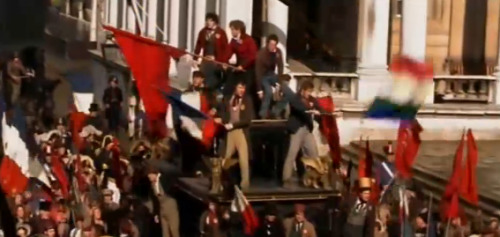 |
| Do you hear the people sing? |
I can hear you complaining. You're saying: "Erin, you've got a length problem. Just tell me if you like the movie, damn it." Ok, enough technical/theoretical discussion. I loved it. It is not great. The pacing problems hurt it. Russell Crowe hurts it, though not for the reasons you think. Crowe is getting a lot of crap for not being up to the rest of the cast vocally and that's not quite accurate (though I won't go as far as Chuck Pierce in defending him). Crowe can sing. He is not awful, in the way that Pierce Brosnan is awful in Mamma Mia! (I have been accused of being a closet lesbian, so it should not surprise that I liked that movie, Brosnan's Mark Knopfler impersonation notwithstanding). Two huge things are disappointing about Crowe's contributions though, both of which I will blame on the director. Javert's part, as written, is a bass part. It makes a great counterpoint to Valjean's soaring roaring tenor and it makes Stars and Javert's Suicide much more emotional by expanding the range of the singer to express those ideas. It might be Crowe's limitations as a singer that prompted them to move away from the vocal depths of Javert's part, and there is no question, the role is reduced by this choice, but I'm not ready to blame that all on Crowe without knowing all the facts. The other problems come in the soliloquies. Crowe isn't given a lot to work with during his soliloquies (walk this parapet like a boss). He does well with others. He's great in disguise and when expressing disgust and he has one of my favorite emotional touches in the whole movie when he sees Gavroche's body (I won't spoil it).
But what hurts it the most, and what really keeps the movie from being truly a masterpiece, is that Tom Hooper is too in love with pointless camera movement (from Pierce's piece: "I'll never watch another Tom Hooper movie until I'm guaranteed by the producers that his damned camera has been riveted to the floor"). The movie blows you away when it settles in and rests in glorious close-up on emotional, gut-wrenching, world-changing heartbreak. The list of incredible scorching emotional moments is almost too long to recount, but let's hit the highlights: Valjean's agonized pacing in "What Have I Done?" which would have won Jackman an Oscar in any other season (sorry, sainted former Presidents trump fictional convicts), Fantine's entire life, but especially "I Dreamed a Dream" (which will win her an Oscar - as an aside: Anne Hathaway's Fantine so hovers over the movie, her presence emotionally overshadows Valjean's death when she welcomes him to the afterlife an hour after she died), Eponine collapsing against the wall in the rain during "On My Own," transforming herself from self-confident street urchin to unhappy unloved poor young girl in one stanza flat, Marius mourning the loss of his revolutionary comrades during "Empty Chairs at Empty Tables," and Cosette watching Valjean die. And in nearly all of these moments, the camera settles in and lets us experience this things without interruption, without flinching. But most of the rest of the time, dear Lord in heaven, it's like a master class in the modern attention span (what used to be called the MTV aesthetic, you know, if you're old). The first fifteen minutes of the film are a series of shots that last no more than two seconds. It's a huge problem.
And then we have the Thernadiers. Helena Bonham Carter and Sasha Baron Cohen have drawn decidedly mixed reactions. Half of the reviews that I have read excoriate the pair of them for . . . not being like the rest of the show. To me, this is like complaining about the Rude Mechanicals in Midsummer for not being in the same show as the rest of the cast: it's the entire point. They are purposefully different. You might not like the characters, which I don't understand, but they are executed perfectly. Most of the people who hate the Thernadiers have not seen the musical, so maybe there is something about them that needs context and explanation, but I thought they were great in the movie. I loved seeing them steal from people left and right. They are perfectly cast. The only mistake Hooper made was to cut Thernadier's song "Harvest Moon." It's a deeply cynical song about cleaning up the revolutionary pups and moving on long after their blood has dried on the streets. It really adds depth and sophistication to the character. They would have done better to cut the Javert chasing Valjean into Paris, which is basically not necessary (as you can easily tell from the 10th Anniversary concert).
One final quibble: in the rush to finish the movie, they forgot to explain that Marius has no idea who saved him from the barricade. That's kind of a major plot point. You need to know that when Marius and Valjean talk at the end, before the wedding. It helps set up the Thernardiers' gate crashing. I have no idea why that happened. Maybe that two minute chunk of singing will make the director's cut.
Ok, this is it, the final paragraph, I swear. The bottom line is that I loved the movie for the same reasons that I love the musical. Every emotional beat that I want is there and executed exquisitely. They even manage to overcome some of the things that I hate about the show, the biggest one being Cosette's singing, which is usually so high that the actress has to get extremely operatic to carry the notes. The intimacy of on-set singing removes the volume problem and it helps tremendously that Amanda Seyfried is a wonderfully expressive performer. I was not annoyed by Cosette at all, was moved deeply by her at one point, and that is a major achievement, in my book. The old rule of thumb for making a great film is to have three good scenes and no bad ones. Les Miserables lives up to that standard. But there are too many stylistic issues, too many pacing issues, and one glaring weak link (I wanna represent for my boy Russell, but Javert he is not) and these problems together mean it isn't a great movie, as much as I wanted it to be great.
At least we'll always have Albert Hall.
Subscribe to:
Posts (Atom)