The first episode of FX's The Bridge (which has a pretty epic amount of material online, btw) starts off with evocative promise. The El Paso PD and the Juarez police find a body on the bridge between Texas and Mexico, the most important and busiest land crossing between the two countries. They tussle over jurisdiction, in a very procedural way, and we think we understand how things are going to be. Then the crime scene techs move the body and it comes apart.
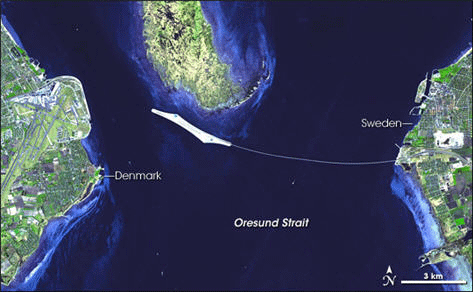
The set up seems so perfectly tailored to the fractious, fraught relationship between the United States and Mexico and all of the socio-economic issues that are bound up in it that it hardly seems believable the show is based on a Danish(!) show about the border between Denmark and Sweden. To be fair, that bridge is much more difficult to cross without being seen, in order to place two halves of different bodies in the middle of it. The idea of borders and crime is so potent that they are developing the idea in Britain, based on the Chunnel. As an American, I don't think I can identify the neuroses that these shows are meant to address, the difficult issues that investigating death lets the show interrogate within the context of these cultures. Whatever the difficulties between France and Britain, the Chunnel hardly seems like a contested boundary. The border between Texas and Mexico? That's a contested boundary.
I did not come into the Bridge unprepared though and this may have colored my expectations for the show. The background noise of the particular crime tale that the Bridge is telling is one of the great crime mysteries of all time: the lost girls of Juarez. My first exposure to this mystery was a novel called 2666 by Roberto Bolaño, a Chilean author who died while writing the novel. It is an epic, discursive tale that curls its way around to Mexico and to the legions of young women who disappear from the maquiladoras, the factories in the north of Mexico that create things cheaply and then get shipped into the U.S., a potent symbol of the economic gulf between the countries, if there ever was one. Over the last twenty years, young women, always between 16 and 24, have disappeared in disturbing numbers, hundreds have disappeared. The reality is probably complex and it's a mortal lock that, in reality, very few of these disappearances are actually related. But humans want narrative and the story of the lost, lonely, dispossessed, poor women who devote their lives to scraping together just enough to power the machinery of the largest economy in the world, which consumes them and their life's work without a thought, and tosses it aside just as easily practically writes itself. There is an evil that pervades the site of so much injustice. Corruption infects the place and it consumes the girls. That is certainly the mood that Bolaño works in and that is how I approached The Bridge.
That's not very fair to the show, of course. No matter how moody you make a murder mystery, you eventually solve mysteries. Rare is the crime show that is purely interested in the culture and the background and not the crimes. Even a show like Twin Peaks which was ALL mood, needed the hook of that dead body wrapped in plastic washing up on the river bank to get it going . . . And it collapsed when the story of that body was told. The fact that I'm comparing The Bridge to Twin Peaks at all, is probably bad for the FX show. Twin Peaks is incredible. I want to watch all of it again right now. I might rewatch the first four episodes of The Bridge, back when it was amazing, when it was all crime, when the detectives had no hope and they were up against what seemed like a supernatural force that was greater than all of them, aiming them, gruesomely, at the crimes of Juarez. That's the show I really really wanted to have. That's not the show I ended up with at the end of season 1. Maybe that's where they go in season 2 . . .
Sunday, October 20, 2013

Friday, October 18, 2013
A Question of Etiquette
The title of this blog post is a fib, a polite one, as befits a discussion of etiquette. There is in fact, no question at all. If you attend an evening of theatricals, of whatever kind they may be, be it dance, or plays, or musicals, or opera, or whatever, the proper end of show etiquette is to clap as enthusiastically as you believe the performance deserved and then to leave the auditorium. There are no credits. The stage door is around the back. Nothing good will come of sticking around the auditorium. You don't have to leave the theater, but you do have to hit the lobbies. There are so many people, and so much work that must be done that you must be kind to them and leave the stage to their capable hands. For every performer you see, there are many more who make it possible for you to see that performer. Be kind to them, take your enthusiasm for the show into the night, into the public, and away from the house. It's the best possible thanks you can offer to the hard working people who made your night possible.
Monday, October 14, 2013
Crème de Violette
Crisis!
I finished it! Well, I completed a readable draft of my very first truly full length play. It's about the craziness of business. And other things. It's very adult. And I am really proud of it. The file name is Crisis Reboot II Fork 5, which tells you the level of effort that went into this play.
Cocktail of the Day:
- Gin - 4.5 cl
- Maraschino Liqueur - 1.5 cl
- Lemon juice - 1.5 cl
That's the IBA definition of the Aviation. However, Wikipedia states that an essential ingredient is 0.75 cl of crème de violette. The kicker is that it is very nearly impossible to find this liqueur. The maker of the classic version, Rothman and Winter, doesn't have a web presence. So it takes an incredible amount of effort to have this cocktail. And you thought collecting cocktails would be easy. Ok, I thought that. And I was wrong, wrong, wrong.

Wednesday, October 9, 2013
Keeping Up With The Cocktails
Political Thought of the Day:
The rumor mill going now suggests that Republicans will put a 6 week debt-limit extension on the table and vote on it so that negotiations can occur. Which seems pretty pointless, if you think that the same set of demands will be in play. Obama will have to agree to the negotiations, to neuter the talking point and then when the GOP reveals that it has simply repeated itself and that there is nothing substantive on offer, we can have the crisis again, only this time Obama gets an extra data point: "I told you that we couldn't function as a government this way and this is way. Partisan demands don't change and governing by crisis is awful."
Fantasy Football Move of the Day:
I looked for a defense in my Yahoo! league. I wasn't very busy most of the day and I was staring at my team. Picking up an extra defense because of a "bad matchup" is exactly the kind of time wasting that happens when you have to be at work, but you don't have anything to do.
Cocktail of the Day:
The Horse's Neck
- 4 cl of brandy
- 110 cl of ginger ale
- Dash of angostura bitters
It's hard to believe this cocktail deserve a name or the word "cocktail" at all. Pretty much exactly what you would expect from the ingredients. Please don't waste good brandy on this.
Tuesday, October 8, 2013
Something New
Three new regular sections (like daily! - like daily, now, not actually daily, that's too much). First, a pithy bon mot about political events. Because I am so very tired of vituperative falsehood that I must shout my corrections into the great void of social media. Second, an update on my fantasy football team. Because if I put it first, you wouldn't read the blog and if I left it until the end, you wouldn't read about my teams (that's right, plural). Duh. And finally, an update on my cocktail experience of the day. Right now, this blog is ugly and dull and this paragraph is also dull. I will fix all of these things. After my next drink . . .
If every issue has the same exaggerated moral weight, than all issues might as well have no moral weight at all. To steal from an outrageously good movie: If every issue is special, then no issue is special.
My quest to become the perfect mixologist in my own home on my own terms starts with the International Bartenders Association list of Official Cocktails.
A. The Stinger:
B. The Sidecar
Political Thought of the Day:
If every issue has the same exaggerated moral weight, than all issues might as well have no moral weight at all. To steal from an outrageously good movie: If every issue is special, then no issue is special.
Fantasy Football Update:
My bench outscored my starters in one league. I won the two matchups in leagues that I play in but don't really care about yet. Water is wet. Statistics soon to follow.My quest to become the perfect mixologist in my own home on my own terms starts with the International Bartenders Association list of Official Cocktails.
Cocktail(s) of the Day:
A. The Stinger:
- 5 cl cognac
- 2 cl creme de menthe
B. The Sidecar
- 5 cl cognac
- 2 cl Cointreau (or Orange liqueur)
- 2 cl Lemon juice
Alton Brown believes the Sidecar is the precursor to the margarita (apologies for the ads). I believe that this is a fantastic drink, if you are craving something sweet, but not cloying or deadened by heavy handed mixers. Go easier on the lemon juice (or use fresh) and use high quality orange liqueurs for the best results, IMO.
Monday, July 8, 2013
Life for a Hot Second on the Appalachian Trail
I don't know much about the history of the Appalachian Trail. I could inform myself, but having been on it for four days, I am now an expert and further research is unnecessary. I can say, without hesitation or equivocation, that the Trail was designed by crazy men (no women would ever be this insane) and walked almost entirely by crazy people. The people who spend their lives on the Trail, they are not crazy. They have bent their lives to the shape of the trail. This means that they have retained their sanity vis a vis real life; it shows perspective.
The first thing that you learn about the Trail is that you do not walk the trail for the view. In Shenandoah National Park, you will find a concrete pillar and a white rectangle (called a blaze) on a tree. It is a narrow entrance to the otherwise uniform randomness of the wall of woods facing you from the road, a tiny arbor. When you enter the arbor in mid-summer, you are entirely surrounded in forest and various shades of brown and green. It is often thickly carpeted with ground cover. The various informative posters around the park remind you that these are invasive species of plants and this is not what a normal deciduous forest looks like, a thought that you will have had many times over, particularly during the hottest and muggiest parts of the day: this doesn't feel like North American forest at all, it feels like the rainforest. It will be several hours from the time that you enter the canopy before there is even a side trail that offers anything like a view from the mountain ridge.
When you are hiking like a normal middle class person with disposable income (both in terms of time and money), side trails are the main focus of a hike. The main trail is a spine that leads you from possible view to possible view and you have a series of views and side trails in mind when you set out on the hike, which might be planned for as long as six hours. In a long day, you might hike six miles and tackle one or two peaks. When you are moving from place to place on the trail, side trails cease to be of any interest at all. If you have to do ten miles that day (which is the minimum you have to do in order to move forward fast enough to get anywhere), you don't want three of those miles on side trails that don't get you further toward your destination. The view can wait. You can take the opportunities that the trail gives you, when it runs along a ridgeline for example, rather than when it hits the top of the peak.
Learning to hike in the Rocky Mountains is poor training for hiking in the Appalachians. Words like "peak" have a different meaning. A peak in the foothills of Colorado has a height of six thousand feet or more. It is well above the scrub line and is flirting with the tree line altogether. You are not ensconced in leafy greenness at the heart of the trail; the view is an inescapable part of the trail and side trails are unnecessary. A peak in the heart of the mountains means you better bring your rock-climbing gear and, in some cases, you snow gear. I crested many peaks in the Appalachians, the tallest topped out at 3700 feet. At the height, there are still plenty of trees around. There is no obvious sign that you have reached the top of the "mountain" except that the trail starts to go downward after a few hundred yards. There is no mistaking a peak in the Rockies.
I think this is the sneaky attraction of the Appalachian Trail; none of the mountains are that high, it should be easy to hike this. It is easy to hike one mountain. But the Appalachian Trail laughs at you, it dares you to take one more peak, to go just two more miles. It's so easy. In Shenandoah, it isn't one or two or ten more miles. It's one thousand miles more of tall hills gussied up as mountains that you learn to hate because the trail never quite seems to be done going up. It tumbles down, zig-zagging back to the ridge, and the climbs forever, suddenly accelerates up, and then slows again, relentlessly up, until you feel like you are always climbing and your calves never knew such pain. If you are momentarily aware that you are going down, your calves still screaming and still working hard, this time to keep you from falling, it only fills you with dread because the inevitable slow death of the upward slope is coming, waiting, laughing.
It is then that you come to dread the word "gap." You cross many of these passes in the mountains. They don't deserve the name pass because the mountains don't tower over them, just a few hundred feet. Cameron Pass in Colorado, for example, is 2,000 feet below the peaks of the mountains on either side of it. But those few hundred feet add up. Every three or four miles is a new gap, a couple hundred feet on either side. A thousand feet here, a thousand feet there, and suddenly you've got a mile. You walk the trail for long enough and the vertical distance traveled starts to hurt, far more than the horizontal distance. Twenty miles in New York City sounds like a lot, but it's a cakewalk - all one surface, basically level ground. Twenty miles in Shenandoah National Park? That's six peaks, over a mile of vertical distance, dirt, rocks, stones, roots, steep downs, stairs up, slopes, ridges and hollows. You can walk 20 miles in NYC without too much effort in six and a half hours. 20 miles in the SNP takes about eleven hours and only if you can muscle through because you have to get your miles in or it will be September in Maine before you know it. Shenandoah National Park is the easiest part of the Appalachian Trail.
When you start the more arduous than necessary climb from 2800 feet to 3500 feet for the twelfth time in two days and you stop cursing because this should be easier than it is, you realize just how insane the Appalachian Trail truly is. Think about the Oregon Trail. It begins in Missouri and seeks to cross the tallest mountains the continent can throw at it. The passes are high up and hard work to find, but you would rather go through a saddle at 10,000 than cross over a 14,000 foot mountain. A pass is an excuse to get away from the peaks, you follow the base of the mountain rather than go over the ridge. You make your life easier, mileage is cheap, elevation is expensive. But the Appalachian Trail was blazed by people who think differently. If you really wanted to walk from Georgia to Maine, the easiest way is to follow the coast. If you need the mountains, then you twist and turn at edges. The last thing on earth that you do is blaze a trail that takes you over as many mountains as possible in the range for the next two thousand miles. But that is exactly what the AT does.
If that doesn't sound like it's for you, I can understand. I spent four days in the mountains and I went sixty miles. 16 miles the first day, 9, the next, 20 the next, and 14 on the final day (in 7 hours, I might add). I hated it. The last day was all about anger and escape. But I had violated the fundamental rule of the mountains, as I discovered, hips waggling into the friendly hostel a ridge runner had built in his home at the entrance to Shenandoah, just for fools such as myself. I listened to the hostelier and his friends banter about how far they were going to get into the trail over the next few days. Their concept of time was fluid, permanently vacation like. In the end, they couldn't settle on where they would be when, so they postponed the decision until a later date. They would phone him(!). Then he turned to me and asked me how far I had come. "I did the park from Swift Run Gap in four days." He let that sink in. "How come you did it so quickly?" My brain was finally able to process now that all of the glucose wasn't going to my legs and I pulled the correct answer out of thin air. I didn't know what I was going to say when I opened my mouth. "I didn't know any better." My generous host, a sage of the mountains, nodded, "That is the correct answer."
I had resolved never to set foot on another mile of the AT on purpose for the rest of my life when the arbor opened the other way onto this rural corner of Virginia (with it's 4G cell service and direct route to Washington, DC). In that moment, I began to change my mind. His friends left at four thirty, hitting the trail for an easy couple of miles before setting up camp for the night. We watched the Tour de France. I had set out on trail with a goal, a finish line, and a deadline. I needed to get somewhere and the trail was a means, though I thought I would enjoy the process. I had met some of the trail who had a goal, too. They need to hit that mountain in Maine, months from now. I drafted in his wake, pushing myself to match his pace, needing to get that twenty mile day in to meet my deadline. Everything was sacrificed to the great god Distance. But the men and women who live by the trail, they have no deadline, no finish line. The point is to be on the trail. Oh there are many who walk the trail, who punish themselves, who make their mileage goals every damn day. They are on the trail, they don't live by it. The ones who live by it, they just are. One day, they look up and they find themselves in Maine and think "Oh. How did I get here?"
Tuesday, June 11, 2013
What's Commercial Got to Do With It?
Diane Ragsdale has been on a tear. She wrote an e-book, In the Intersection, she runs an excellent blog, Jumper, and she has given a talk called Living in the Struggle. The talk is a full length academic talk, so it is a bit of a #longread, but it's absolutely worth it. In the talk, she discusses some of the trends among major regional theatres toward safer programming and more assured revenue streams, she calls this a move toward "commercialism." This concern is long standing in the not-for-profit arts community and Ragsdale is far from the only one concerned with the trends in American regional theatre. Todd London has also written a passionate article on the subject called, What Price Idealism, that pleas for regional theatres to return to their innovative roots and reject the creeping commercialism of partnering with for profit groups to take work to Broadway. Both London and Ragsdale have done great work here, but I have to take issue with the idea that what regional theatres are doing qualifies as commercialism and with the underlying assumption that the for-profit world has nothing to teach the regions.
If you want to start a philosophical argument about the nature of theatre, just utter the words "Theatres should act more like businesses." Many not-for-profit practitioners bristle at the very idea that our cultural enterprise has anything in common with pure profit maximizing institutions, many of which are rapacious and conscienceless. Truth be told, not-for-profit theatres are unique and they should not act completely like businesses, because that would be a betrayal of their fundamental mission. But many of these arguments cherry pick by highlighting the worst aspects of business and of poorly run businesses and conflate regional theatres' revenue maximization strategies with "acting like a business" or engaging in commerce.
As it happens, I agree that many regional theatres are making poor strategic decisions in favor of short-term revenue production, but this isn't because they are acting like businesses, it's because they are acting like bad businesses. The Economist has done a masterful job covering the stagnation in Japan over the past twenty years. This article, from 2011, has the same theme as this one, from 2004. Japan has not dealt with businesses that have no serious future, but they do not have the courage to let these businesses fail. They limp along, without innovating or producing much of value, or living up to their original promise, and they continue to exist because it would be painful for the national psyche to let them fail en masse. Corporate innovation is not a strong suit for Japanese businesses, which prefer the assiduous pursuit of goals, not dreaming up new ideas of how to achieve those goals or of new goals. Bad companies make bad assumptions about revenue projections. Companies go south by growing big too quickly. Bad companies limp along for years by nursing existing revenue streams and failing to innovate new products and new business models. This should all sound very familiar to those with experience in the land of not-for-profit theatres of a certain size (usually big). Human beings are notoriously bad at identifying sunk costs (I love this extract calling the sunk cost effect a "maladaptive economic practice" - scientists are the best).
To call this collective set of revenue maximizing behavior "commercialism" is to ignore the positive examples of great companies in the private sector that don't do any of that. Google enables its employees to have side projects (and Apple has toyed with the idea too). Can you imagine what would happen if every regional theatre started acting like that business? IBM is a technology firm that has existed from over one hundred years (this Economist piece is a good overview). It has reinvented itself several times over. How many theatres have the nerve to identify the changes necessary in what they consider their core product and to entirely reinvent themselves? How many theatres have the emphasis on design that Apple has? Or that can focus relentlessly on improving the process of production the way that Toyota has? Toyota has a ton of things to teach the theatre world (empowering every employee on the line to stop it and point out a flaw and requiring, REQUIRING, its employees to regularly suggest improvements to the process, to name just two awesome ideas).
In the end, I do not believe that theatres emphasizing safe shows over riskier material, theatres that seek the widest audience, that they know, are becoming too much like businesses, too commercial. They are making a huge mistake because they are becoming too much like bad businesses. How many theatres are truly laser focused on maximizing their resources to put on the best show possible, which is their product after all? How many of the have the courage to abandon any pretence of relying on fickle ticket revenue and shift budgets accordingly? How many theatres get smaller in a responsible and orderly fashion? How many theatres have given up specializing in their own marketing and let others with more experience handle that service? Inditex is a firm that does not spend a single dime on advertising and yet Zara has gone from being a Spanish brand to being a global one. What does that tell us about marketing?
I agree that not-for-profit theatres are not for-profit enterprises. They should not be as ruthless about maximizing profit or as focused on quarterly shareholder value. But there are a lot of best practices in the business world that could make a real difference in not-for-profit theatre and we owe it to our staffs, to our patrons, and to our communities to find them and apply them.
If you want to start a philosophical argument about the nature of theatre, just utter the words "Theatres should act more like businesses." Many not-for-profit practitioners bristle at the very idea that our cultural enterprise has anything in common with pure profit maximizing institutions, many of which are rapacious and conscienceless. Truth be told, not-for-profit theatres are unique and they should not act completely like businesses, because that would be a betrayal of their fundamental mission. But many of these arguments cherry pick by highlighting the worst aspects of business and of poorly run businesses and conflate regional theatres' revenue maximization strategies with "acting like a business" or engaging in commerce.
As it happens, I agree that many regional theatres are making poor strategic decisions in favor of short-term revenue production, but this isn't because they are acting like businesses, it's because they are acting like bad businesses. The Economist has done a masterful job covering the stagnation in Japan over the past twenty years. This article, from 2011, has the same theme as this one, from 2004. Japan has not dealt with businesses that have no serious future, but they do not have the courage to let these businesses fail. They limp along, without innovating or producing much of value, or living up to their original promise, and they continue to exist because it would be painful for the national psyche to let them fail en masse. Corporate innovation is not a strong suit for Japanese businesses, which prefer the assiduous pursuit of goals, not dreaming up new ideas of how to achieve those goals or of new goals. Bad companies make bad assumptions about revenue projections. Companies go south by growing big too quickly. Bad companies limp along for years by nursing existing revenue streams and failing to innovate new products and new business models. This should all sound very familiar to those with experience in the land of not-for-profit theatres of a certain size (usually big). Human beings are notoriously bad at identifying sunk costs (I love this extract calling the sunk cost effect a "maladaptive economic practice" - scientists are the best).
To call this collective set of revenue maximizing behavior "commercialism" is to ignore the positive examples of great companies in the private sector that don't do any of that. Google enables its employees to have side projects (and Apple has toyed with the idea too). Can you imagine what would happen if every regional theatre started acting like that business? IBM is a technology firm that has existed from over one hundred years (this Economist piece is a good overview). It has reinvented itself several times over. How many theatres have the nerve to identify the changes necessary in what they consider their core product and to entirely reinvent themselves? How many theatres have the emphasis on design that Apple has? Or that can focus relentlessly on improving the process of production the way that Toyota has? Toyota has a ton of things to teach the theatre world (empowering every employee on the line to stop it and point out a flaw and requiring, REQUIRING, its employees to regularly suggest improvements to the process, to name just two awesome ideas).
In the end, I do not believe that theatres emphasizing safe shows over riskier material, theatres that seek the widest audience, that they know, are becoming too much like businesses, too commercial. They are making a huge mistake because they are becoming too much like bad businesses. How many theatres are truly laser focused on maximizing their resources to put on the best show possible, which is their product after all? How many of the have the courage to abandon any pretence of relying on fickle ticket revenue and shift budgets accordingly? How many theatres get smaller in a responsible and orderly fashion? How many theatres have given up specializing in their own marketing and let others with more experience handle that service? Inditex is a firm that does not spend a single dime on advertising and yet Zara has gone from being a Spanish brand to being a global one. What does that tell us about marketing?
I agree that not-for-profit theatres are not for-profit enterprises. They should not be as ruthless about maximizing profit or as focused on quarterly shareholder value. But there are a lot of best practices in the business world that could make a real difference in not-for-profit theatre and we owe it to our staffs, to our patrons, and to our communities to find them and apply them.
Subscribe to:
Posts (Atom)